

The AI Myth: Why Machines Might Be Tanking Your Clean Claim Rate
- yourrevbilling
- 1 day ago
- 5 min read
In the modern optometry practice, the promise of Artificial Intelligence (AI) feels like a siren song. Software vendors promise "set it and forget it" workflows, claims that magically correct themselves, and a "Clean Claim Rate" that hovers near 99%. It sounds like a dream: the machine handles the boring stuff while you focus on patient care.
But there is a growing, expensive disconnect in the industry. While your software might tell you your claims are "clean," your bank account might be telling a different story. The truth is, AI alone is often the very thing tanking your actual reimbursement. At Revolutionary Revenue Management, we see it every day: practices that have "automated" their way into a revenue crisis.
The myth of the all-knowing machine is leading many optometrists into a billion-dollar blind spot. Here is why the "Clean Claim Rate" is a vanity metric and why the human-over-machine approach is the only way to protect your practice’s financial health in 2026.
The Clean Claim Rate Illusion: Why "Passed" Does Not Mean "Paid"
If you take one thing away from this article, let it be this: A clean claim rate is a measure of technical accuracy, not a guarantee of payment.
Most RCM software defines a "clean claim" as one that passes a set of basic front-end edits. Did you include a NPI? Is the zip code five digits? Is there a diagnosis code attached? If the AI sees a checkmark in those boxes, it high-fives itself and sends the claim into the void.
However, passing these technical hurdles is the bare minimum. The real "war" happens after the claim hits the payer's system. According to recent research, many organizations with high clean claim rates still experience massive denial spikes weeks later. Why? Because the AI didn't catch that the patient’s eligibility shifted yesterday, or it didn't recognize that the specific combination of CPT and ICD-10 codes violates a new, unannounced payer policy.
If your denial management strategy relies solely on what the software tells you is "clean," you are essentially flying a plane with a broken fuel gauge. You might think you’re soaring, but you’re actually running on empty. To dig deeper into why your current strategy might be failing, check out our guide on 10 reasons your optometry denial management isn't working.

The Payer’s Secret Weapon: When AI Fights AI
It is important to remember that you aren't the only one using AI. Insurance companies have deployed incredibly sophisticated algorithms designed to do one thing: find reasons to deny your claims at scale.
This is the "War of the Machines." Your practice's AI is trying to push claims through, while the payer’s AI is looking for any "nuanced" reason to bounce them back. This has led to a startling trend where 61% of physicians report that health plans' use of AI is increasing prior authorization denials.
Payer AI is aggressive, and it’s updated daily. Generic provider-side AI: the kind bundled into your standard EHR: simply cannot keep up. It is "broadly accurate but specifically useless." It doesn't know that a specific regional carrier just changed their frequency limits for retinal imaging, or that Medicare's latest 2.5% cut requires a different approach to your optometry revenue cycle management.
When your automated system hits a wall, it doesn't "think" its way around it. It just stops. This is where the human element becomes your greatest competitive advantage.
Why Optometry is Too Nuanced for Generic Algorithms
Optometry billing is a specialized beast. You aren't just dealing with medical insurance; you're navigating the labyrinth of vision plans like VSP and EyeMed, which have their own bizarre sets of rules.
AI struggles with the "Grey Areas" of eye care, such as:
The Medical vs. Vision Divide: Determining when an exam transitions from a routine vision check to a medical encounter requires clinical judgment that an algorithm often lacks.
Coding for Medical Necessity: AI can suggest a code, but it doesn't understand the "story" of the patient’s chart. If the documentation doesn't support the code, that "clean" claim will trigger an audit or a clawback later. For more on this, see the ultimate guide to medical billing for optometrists.
Specialty Modifiers: Using modifiers like -25 or -RT/-LT correctly is the difference between getting paid and getting a rejection letter. AI often defaults to "safe" options that result in under-coding and lost revenue.
Strategy: The Human-Over-Machine Hybrid
At Revolutionary Revenue Management, we don't ignore technology: we use it as a tool, not a replacement. We use specialized tools like OptiCode to streamline workflows, but we always have expert human eyes overseeing the process.
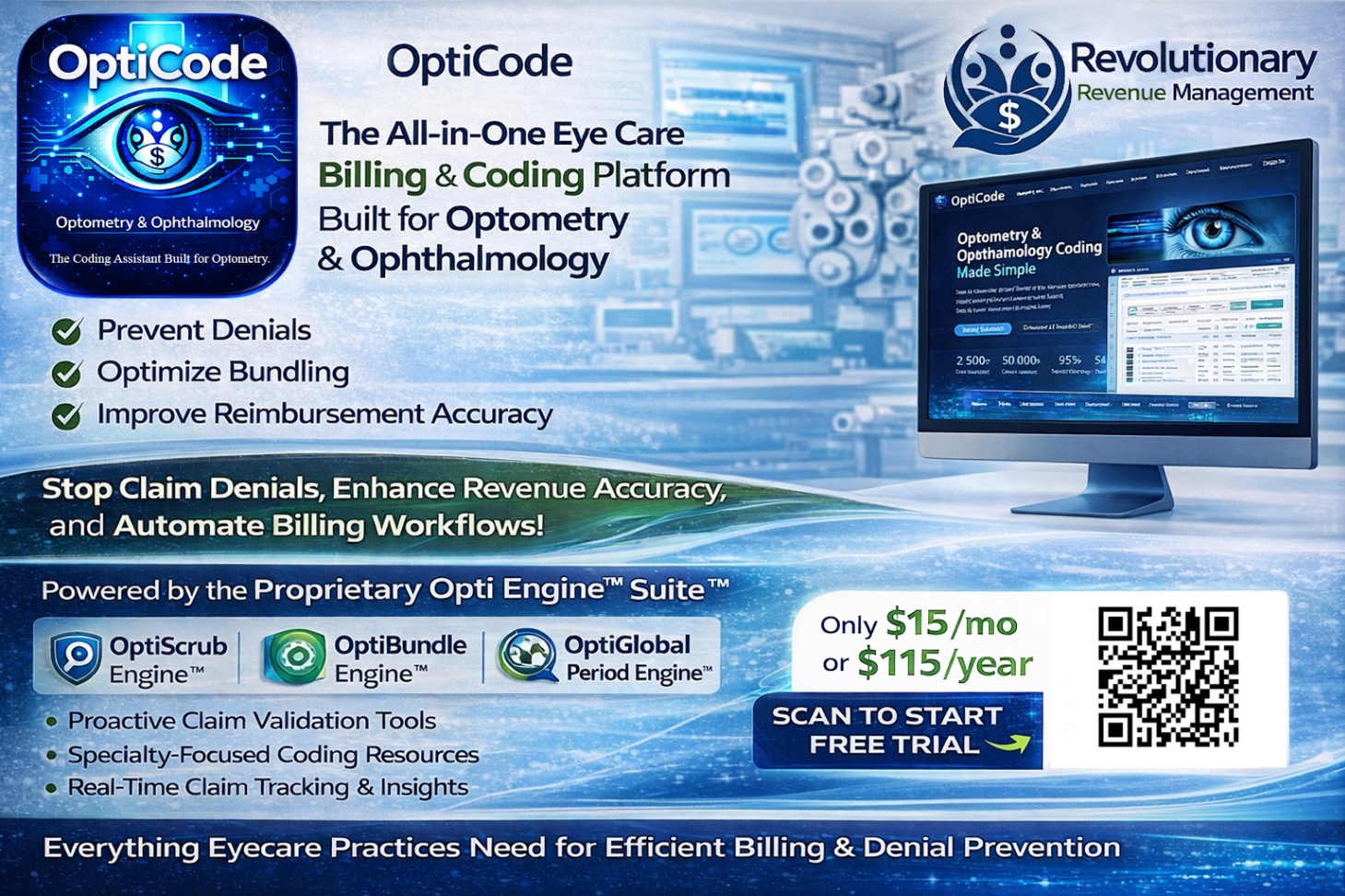
As shown in the image above, tools like OptiCode are designed to prevent denials and optimize bundling, but their true power is unlocked when managed by RCM professionals who understand the nuance of eye care.
The "Set It and Forget It" Trap: The Hidden Price of Automation
When a practice owner "forgets" about their billing because the software says it's handled, they are inviting "silent" revenue leakage. AI doesn't get frustrated when a claim is stuck in "pending" for 45 days. AI doesn't pick up the phone to argue with a carrier about a wrongful denial.
Manual oversight catches errors at the intake level. In fact, over 25% of denials stem from avoidable errors in patient intake and eligibility verification. If your AI isn't catching the fact that a patient has reached their frequency limit for frames, you’ve already lost money before the patient even sits in the chair. You can avoid these traps by learning how to avoid eligibility verification pitfalls.
Quick Tip: Audit Your "Clean" Claims
Ask your billing department (or your current software provider) for a report on "Clean Claims vs. Paid Claims." If there is a gap larger than 3%, your AI is failing you. Those "clean" claims are likely sitting in a denial queue, and the clock is ticking on your timely filing limits.

How to Pivot: Moving Beyond the Machine
So, how do you fix a tanking clean claim rate when the machines are working against you? You need to implement a strategy that prioritizes proactive prevention over automated submission.
Upstream Verification: Don't wait for the AI to scrub the claim after the exam. Verify eligibility and authorization before the patient arrives. Human expertise is required here to interpret complex vision plan benefits that software often misreads.
Payer-Specific Rule Validation: Your RCM process must be tailored to your specific payer mix. A claim that is "clean" for Blue Cross might be "dirty" for a specialized vision plan.
Real-Time Coding Feedback: Instead of letting the AI "fix" codes silently, use a system that alerts your team to potential errors so they can learn and improve documentation. This is critical for staying ahead of ICD-10 changes in 2026.
Specialized Human Oversight: Outsource to a partner that understands optometry specifically. Generic billing companies use the same "broadly accurate" AI that is already failing you. At Revolutionary Revenue Management, we focus exclusively on the eye care niche.
Final Thoughts: The Future is Hybrid
AI is a fantastic assistant, but it is a terrible master. If you let it run your revenue cycle without professional human intervention, you are essentially leaving your practice's financial future to a "black box" algorithm.
The most successful optometry practices in 2026 will be those that embrace high-tech tools: like the OptiCode app: while maintaining a high-touch human oversight system. By combining the speed of machines with the specialized knowledge of RCM experts, you can finally move past the "Clean Claim Myth" and start seeing the actual revenue your hard work deserves.
Don't let your revenue tank because a machine couldn't tell the difference between a routine exam and a medical necessity. Take control of your cycle today. If you're ready to see the difference that specialized, human-led revenue management can make, explore the benefits of outsourcing vision billing and let’s get your clean claim rate to mean what it should: paid in full.
Comments