

How to Avoid the Biggest Medical Billing for Optometrists Pitfalls in 2026
- yourrevbilling
- 5 hours ago
- 5 min read
Let’s be honest: you didn’t go to school for eight years because you had a burning passion for CMS-1500 forms and NCCI edits. You went because you wanted to help people see better. But here we are in 2026, and the "business side" of optometry: specifically medical billing for optometrists: has become a complex labyrinth that feels like it was designed by people who enjoy puzzles way too much.
As we move through 2026, the stakes for your optometry revenue cycle management (RCM) have never been higher. Payers are getting pickier, audits are getting more frequent, and "close enough" is no longer a valid strategy for getting paid. If your practice is still treating billing like an afterthought, you aren’t just leaving money on the table; you’re practically handing it back to the insurance companies with a "thank you" note.
At Revolutionary Revenue Management, we see the same traps catching even the most seasoned practices. Here is how to navigate the 2026 landscape without losing your mind: or your revenue.
1. The Diagnostic Test Trap: "Doing" Isn't "Billing"
One of the most common pitfalls we see in 2026 is the assumption that performing a test automatically entitles you to reimbursement. In the eyes of an auditor, if you didn't interpret the results in writing, the test didn't happen.
The Mistake: Billing for OCT imaging, visual fields, or fundus photography without a formal, documented "Interpretation and Report" (I&R).
In 2026, payers are strictly enforcing the requirement that every diagnostic test must have its own clinical decision-making documentation. You can’t just click a box in your EHR and call it a day. You need to document:
The clinical necessity (why you did it).
The findings (what you saw).
The clinical impact (how this changes the patient’s treatment plan).
Quick Strategy: Never bill a diagnostic test as a "wellness" screening to a medical payer. If the patient doesn't have a specific medical complaint or symptom, that OCT is a self-pay service. Don't risk a compliance headache for a $40 claim.

2. The Identity Crisis: Medical vs. Vision Insurance
The struggle is real. In 2026, patients still walk in saying, "I’m here for my eye exam," and expect you to figure out which of their three cards covers what.
The Pitfall: Billing a medical complaint (like dry eye or flashes) to a vision plan, or billing a routine refraction to a medical carrier.
When you misclassify an encounter, you trigger a chain reaction of denials that can take months to untangle. Optometry billing services exist specifically to prevent this "Identity Crisis." Your front desk is your first line of defense. They must document the Chief Complaint with laser precision.
Routine: "I need new glasses."
Medical: "My eyes feel gritty and red."
If the patient starts with a routine complaint but you find a medical issue, you have to be very clear about how you transition that visit. Mismanaging this is the fastest way to blow your optometry revenue cycle management metrics.
3. The E/M Coding "Click-Happy" Syndrome
EHR systems are great: until they aren't. Many practices rely on "auto-coding" features that suggest a level of service based on how many boxes you checked.
The Pitfall: Selecting code levels based on EHR checkboxes rather than Medical Decision Making (MDM) or Total Time.
In 2026, the volume of your documentation doesn't determine your code; the complexity of your thinking does. For encounters like diabetic retinopathy management or advanced glaucoma cases, you are likely looking at moderate to high MDM. This often supports codes like 99214 or even 99215, provided you’ve documented:
The number and complexity of problems addressed.
The amount and/or complexity of data to be reviewed.
The risk of complications and/or morbidity of patient management.
Strategy: Stop letting your software dictate your revenue. If your MDM supports a 99214 but you’re billing a 92014 out of "fear" of an audit, you are costing your practice thousands of dollars a year. Learn the nuances of 99214 vs 92014 to maximize your legitimate earnings.
4. Ignoring the NCCI Quarterly Updates
The National Correct Coding Initiative (NCCI) isn't exactly light bedside reading, but ignoring it is a recipe for disaster. NCCI edits tell you which codes can: and cannot: be billed together on the same day for the same patient.
The Pitfall: Bundling services that are supposed to be separate or unbundling services that must stay together.
For example, certain imaging procedures might be bundled with a surgical procedure performed on the same day. If you don't use the correct modifiers (like -25 or -59) when appropriate: and only when appropriate: your claims will bounce faster than a rubber ball.
Quick Tip: Check the NCCI updates every quarter. Or, better yet, use a tool like the OptiCode app which is built to handle these complex rules for you.

5. The "Set It and Forget It" Mentality with Credentialing
You can be the best coder in the world, but if your credentialing is out of date, those checks aren't coming.
The Pitfall: Missing re-credentialing deadlines or failing to update your CAQH profile.
Insurance companies change their requirements constantly. In 2026, we’ve seen an uptick in "silent" disenrollment where a practice doesn't even realize they are out of network until the denials start pouring in. This is why professional optometry billing services usually include or offer credentialing oversight: it's too important to leave to chance.
6. DIY Revenue Cycle Management (The Burnout Path)
Many owners try to keep everything in-house. "My tech can do the billing in their downtime," is a phrase that keeps us up at night.
The Pitfall: Treating billing as a secondary task rather than a specialized profession.
When your staff is busy checking in patients, performing pre-tests, and selling frames, the billing gets rushed. Errors happen. Denials sit in a folder labeled "to do later." Before you know it, your Aging AR is over 90 days and your cash flow is a desert.
If you want to see what's actually happening behind the scenes of your practice, you might need an AR Clean Up to get back on track.

How Revolutionary Revenue Management Fixes the Mess
We don't just "submit claims." We manage the entire lifecycle of your revenue. When you partner with us, we act as an extension of your practice, ensuring that every dollar you earn actually makes it into your bank account.
Proactive Denial Management: We don't just wait for denials; we analyze why they happened and fix the root cause.
Specialized Expertise: We know the difference between a 92083 and a 92133 because optometry is all we do.
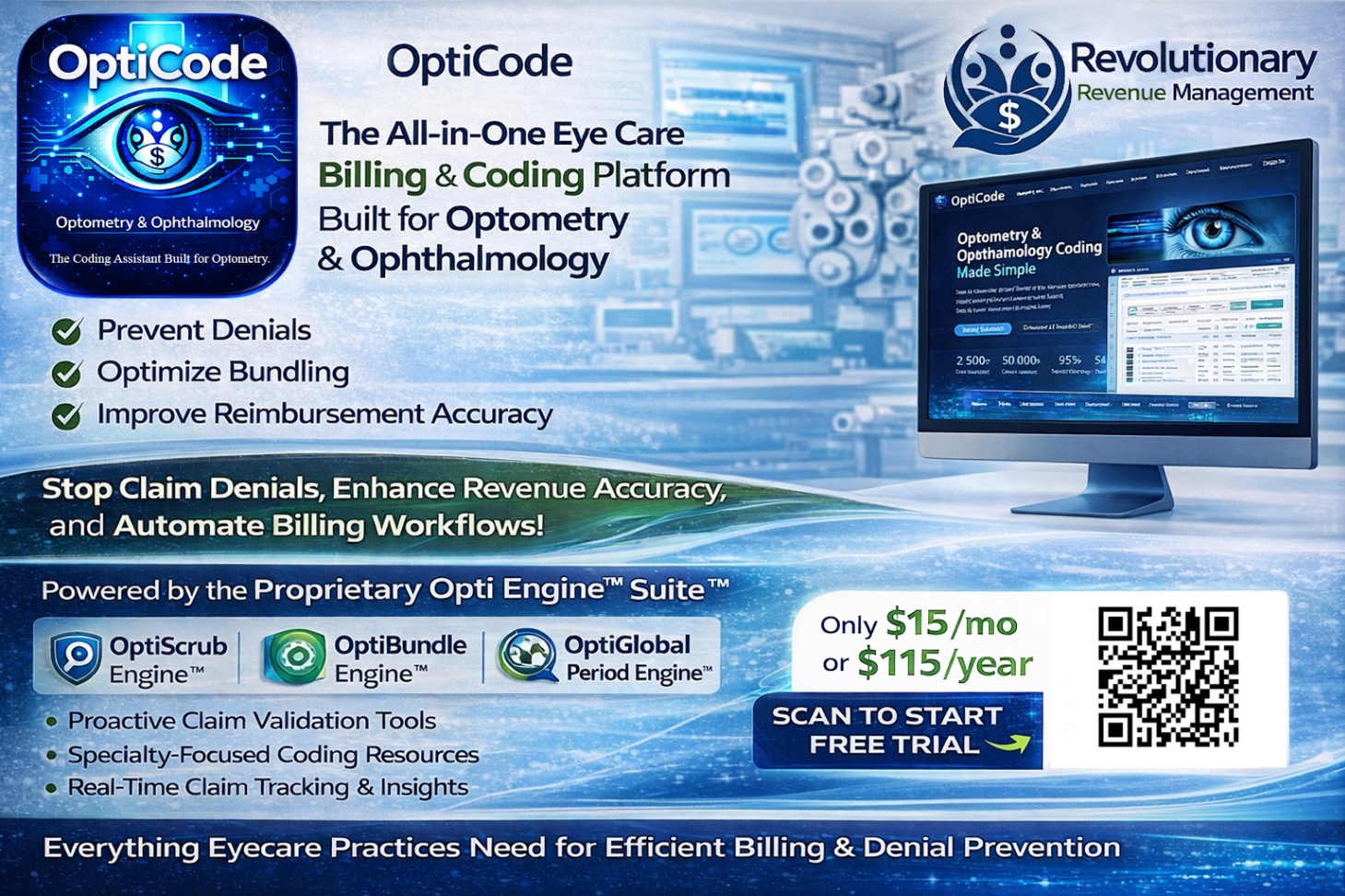
OptiCode Integration: We leverage the best technology, like the OptiCode platform, to ensure coding accuracy and optimize bundling.
Final Thoughts
The year 2026 isn't going to be "easier" for medical billing. The rules will keep changing, and the payers will keep finding new ways to deny your hard-earned claims. But you don't have to face it alone.
By focusing on precise documentation, understanding the shift toward Medical Decision Making, and staying on top of NCCI edits, you can avoid the biggest pitfalls. And if you’re tired of the billing headache altogether? That’s what we’re here for.
Ready to stop stressing about your billing?Contact us today and let’s get your revenue cycle running like a well-oiled machine. Whether you need a full RCM overhaul or just want to learn more about our practices, we’ve got your back.
Comments